
How to Build a Plasma Polishing, Deburring & Ultrasonic Cleaning Cell
How to Build a Plasma Polishing, Deburring & Ultrasonic Cleaning Cell
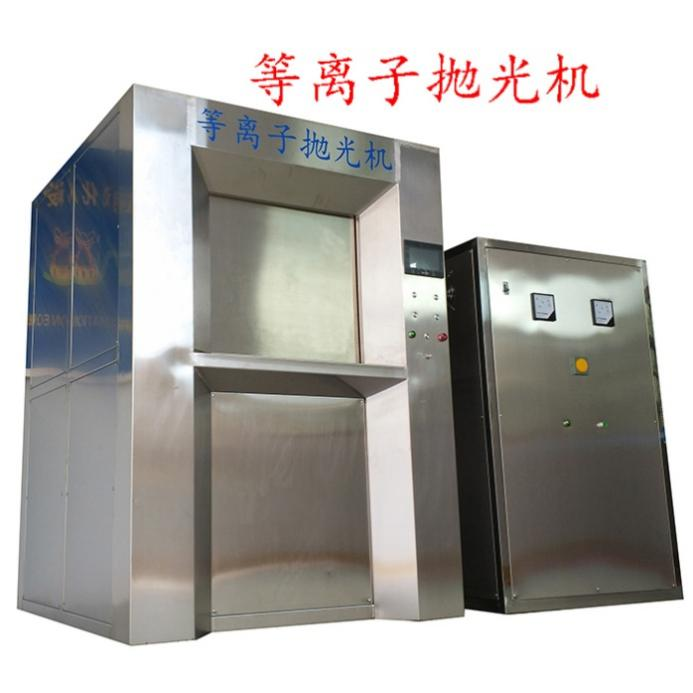
Cover: BY-800A plasma polishing machine — the polishing station inside a combined deburring, polishing and ultrasonic cleaning cell.
Building a combined finishing cell is a layout and material-flow decision before it is a purchasing decision. The cell works when a part enters at the deburring or polishing station, leaves the electrolyte zone, passes through ultrasonic cleaning, and exits free of residue — without re-entering general workshop traffic between stages.
The hardware side is simpler than the flow side. Plasma polishing, plasma deburring and ultrasonic cleaning each exist as a mature machine category, and BAYI (Dongguan Bayi Automation Equipment Co., Ltd, a China-based manufacturer established in June 2017) supplies all three, together with sewage treatment equipment and automation transformation and upgrading services. The difficulty is that each stage imposes a different constraint on the next: carrier size, electrolyte carry-over, cycle time, electrical supply, exhaust, and wastewater.
This guide sets out a build sequence that a production engineer or procurement team can follow, using BAYI's documented equipment range as the reference hardware. Every machine parameter, certification number and capacity figure quoted below comes from manufacturer documentation or published technical sources; where a figure is not documented, the guide says so rather than estimating it.
What a Three-Process Finishing Cell Actually Is
A three-process finishing cell is a controlled production island in which parts move through a plasma deburring or polishing stage and an ultrasonic cleaning stage on a defined transfer path, with each stage isolated from the others by fixtures, liquid circuits and exhaust.
It is not three machines placed side by side. In a cell, the gap between stages is engineered: the transfer path is fixed, the time a part spends wet is controlled, and the liquid that leaves the plasma tank does not enter the cleaning tank. Those three variables, not the polishing performance itself, decide whether the cell produces consistent output.
Plasma polishing and plasma deburring share one platform in BAYI's range — the BY series machine is documented as a plasma polishing deburring machine — while ultrasonic cleaning and sewage treatment are separate equipment categories within the same portfolio. That matters for integration, because a supplier that already builds all stages can align tank materials, fixturing and controls instead of leaving the interfaces to the buyer.
| Stage | Function inside the cell | BAYI equipment category | Constraint it imposes on the layout |
|---|---|---|---|
| Plasma deburring | Removes burrs and edge material from conductive metal workpieces | Plasma deburring machine (BY series) | Requires a conductive workpiece, an electrolyte tank and fume extraction |
| Plasma polishing | Refines surface roughness and removes fine burrs and surface contamination in one operation | BY-100A, BY-500A, BY-800A, BY-1000A | Hanger space and current class set the maximum part envelope and throughput |
| Ultrasonic cleaning | Removes electrolyte residue and loose particles from surfaces, blind holes and threads | Ultrasonic cleaning machine | Must be liquid-separated from the electrolyte circuit |
| Wastewater handling | Treats process liquid before discharge or reuse | Sewage treatment equipment | Adds floor space and piping between the two wet stages |
Why Separate Stations Stop Scaling
Separate deburring, polishing and cleaning stations remain workable while volume is low, because manual handling absorbs the inefficiency. The breakdown becomes visible when output stabilises at a higher level and four things happen at the same time:
- Parts wait in bins between stages, so work-in-progress grows faster than output.
- Electrolyte carried on the part dries before cleaning, which makes residue harder to remove and pushes rework upward.
- The stages run at different cycle times, and the slowest stage sets cell output regardless of how fast the others are.
- Rework and scrap are recorded against a department rather than a stage, so the real cause stays invisible.
An integrated cell addresses all four by turning transfer time and liquid separation into engineering variables instead of workshop habit. The engineering effort moves forward into layout, which is where it can still be changed cheaply.
What the Process Literature Already Confirms
Plasma polishing is not a single-purpose buffing step. Plasmotion describes the process as an interaction of plasma physics and electrochemistry that simultaneously cleans, polishes and deburrs workpieces. A trade publication describes electrolytic plasma polishing as improving surface quality while removing ultra-fine burrs, particulate contamination and filmic contaminants in a single operation.
Material scope is documented for the metals that dominate precision work. The process is described as applicable to mechanically or additively manufactured parts in stainless steel, titanium and titanium alloys, and a peer-reviewed study reports plasma polishing achieving surface roughness (Ra) values below 0.02 μm on complex metal parts.
Application scope is broad enough to justify a shared cell. Hannover Messe technical material lists medical, mechanical engineering, life sciences, toolmaking, automotive, dental and additive manufacturing as application industries. On the demand side, Grand View Research values plasma cleaning and surface treatment machines — a category that includes polishing — at USD 408.2 million in 2024, projected to reach USD 753.2 million by 2033. That figure covers a wider equipment category than plasma polishing alone and should be read as directional context rather than as a polishing-machine market size.
If plasma already removes burrs and contaminants in one operation, why add ultrasonic cleaning at all? The answer is residue. The part leaves the electrolyte bath wet, and residue held inside blind holes, threads and additively manufactured internal channels is a recurring source of downstream cosmetic and corrosion complaints. The ultrasonic stage sits exactly where the chemistry changes from process liquid to cleaning liquid, which is why its position in the layout matters more than its size.
Cell Architecture: Four Blocks and Three Interfaces
Layout planning becomes manageable once the cell is decomposed into four blocks and three interfaces.
Block 1 — Load, fixturing and part-family routing. This is where hanger design is fixed. BAYI publishes an available hanger space of 360 × 260 × 200 mm for the BY-100A, which is the practical ceiling on a single part or batch envelope on the smallest standard model. Parts that exceed it force a different model, not a different fixture.
Block 2 — Plasma stage. Deburring and polishing can be a single integrated machine or two sequential passes on the same platform. BAYI's standard models are 100A, 300A, 500A and 800A, with non-standard models from 1000A to 2500A; the current class is chosen from part geometry and required surface result, not from budget alone.
Block 3 — Ultrasonic cleaning. The cleaning tank is treated as a separate wet zone with its own drain, its own temperature control and its own drag-out management. Placing it directly downstream of the plasma stage shortens the wet-to-wet transfer to seconds rather than minutes.
Block 4 — Wastewater and exhaust. BAYI supplies sewage treatment equipment alongside the finishing machines, which allows the liquid loop to be closed inside the project rather than retrofitted later. On additive parts, a dusting and fume extraction system is normally specified as matched equipment.
The three interfaces are part transfer, liquid separation and air handling. Most failed integration projects fail at the second interface, when electrolyte migrates into the cleaning bath and both tanks drift out of specification within weeks.
Step-by-Step: Designing the Cell in Seven Steps
Step 1 — Build the part-family list before selecting any machine. Group parts by material, maximum external dimension and burr location. Stainless steel, titanium and titanium alloys behave differently in the same tank, and a cell designed around one family will underperform on another. The list, not the catalogue, is the input to every later decision.
Step 2 — Decide which stages each part family actually needs. Some families require deburring only; others require deburring, polishing and cleaning; a third group is polished and cleaned without a deburring pass. Writing this matrix down prevents the common mistake of sizing every machine for the worst-case part.
Step 3 — Size the plasma stage from carrier space and current class. Take the largest part envelope, add the fixture wall thickness, and compare the result against the published hanger space of the candidate model. Then confirm the current class against the required surface result. BAYI designs special equipment according to product size, shape and yield, so a part family that does not fit a standard envelope is a specification input rather than a dead end.
Step 4 — Choose the transfer mode. Three options exist in practice: manual transfer with a fixed trolley route, semi-automatic transfer between adjacent tanks, and fully automatic transfer on a rail or conveyor. BAYI's automation transformation and upgrading service covers this decision, and the same capability appears in special machine formats: tape-type plasma polishing equipment that takes square material as a whole roll without cutting, chain-type equipment that automatically collects square material into a roll for polishing, and long-tube plasma polishing equipment for pipes over two metres in continuous production. Where a part family is a continuous profile rather than a discrete item, these formats replace the transfer discussion entirely.
Step 5 — Match the cleaning stage to the residue risk. The cleaning stage is specified from geometry: open sheet parts need less dwell time than parts with blind holes, threads or internal channels. Because the residue risk drives the cleaning specification, it should be written as an acceptance criterion (no visible residue after drying, no residue transfer onto a white cloth) rather than as a tank size.
Step 6 — Close the liquid loop. Route rinse water and spent cleaning liquid to the treatment unit, and define who owns discharge compliance. Including sewage treatment equipment in the same purchase keeps the responsibility with one supplier and removes the most common gap between the machine list and the environmental permit.
Step 7 — Validate with a sample run and a written acceptance list. BAYI provides a mechanical test report and video factory inspection, applies 100% testing, and supports buyers remotely after delivery. The sample run should reproduce the intended cell sequence rather than testing the polishing machine in isolation, because the sequence is what the buyer is actually qualifying.
Capacity, Footprint and Utility Planning
BAYI reports a monthly capacity of 70,000–110,000 medium parts and an annual output of 200,000 units, with standard lead time of 30–45 days and a minimum order quantity of one unit. For a buyer building a first cell, that combination means the capacity of the supplier is unlikely to be the constraint; the constraint is the internal cycle time of the cell itself.
Footprint planning starts from the smallest standard model, because its published dimensions set the minimum module size. The BY-100A has a maximum output current of 100 A, 30 kW power, a three-phase five-wire 380 V input, a 0.5–0.8 MPa gas source, machine dimensions of 1150 × 1200 × 1800 mm at 150 kg, a separate power cabinet of 850 × 600 × 1500 mm at 100 kg, and an available hanger space of 360 × 260 × 200 mm. The inner groove main body is 316L stainless steel.
| Planning item | BY-100A documented value | What it means for the cell layout |
|---|---|---|
| Electrical supply | 30 kW, three-phase five-wire 380 V | Reserve a dedicated feeder and panel space before the layout is frozen |
| Compressed air | 0.5–0.8 MPa | Dry air line required at the plasma station |
| Floor footprint | Machine 1150 × 1200 × 1800 mm (150 kg); power cabinet 850 × 600 × 1500 mm (100 kg) | Two separate footprints must be planned, not one |
| Carrier envelope | 360 × 260 × 200 mm hanger space | Defines the largest single part or batch on this model |
| Tank material | Inner groove main body in 316L stainless steel | Sets the electrolyte compatibility basis for the whole wet zone |
Model Selection Matrix for the Plasma Stage
The table below compares only documented configurations. Where a parameter is not published, it is omitted rather than estimated.
| Model | Documented type | Documented parameters and scope | Role in the cell |
|---|---|---|---|
| BY-100A | Metal plasma polishing machine | 30 kW; max output 100 A; 380 V three-phase five-wire; 0.5–0.8 MPa air; hanger space 360 × 260 × 200 mm; medical care, confidential processing, 3D printed dentures, precious metals and gold jewelry | Entry-size polishing or combined deburring/polishing station |
| BY-500A | Jewelry plasma polishing machine | Stainless steel construction; jewelry application; deburring rate ≥ 99.9%; fully automatic control system; 1-year warranty; video technical support out of warranty | Jewelry and small precious-metal cell |
| BY-800A | Titanium plasma polishing machine | 316L stainless steel inner groove; deburring rate ≥ 99.9%; fully automatic control system; medical care, confidential processing, 3D printed dentures, precious metals and gold jewelry | Titanium and medical-device polishing station |
| BY-1000A | Fully automatic plasma polishing machine | Stainless steel construction; deburring rate ≥ 99.9%; fully automatic control system; medical devices, aerospace, 3C electronics and precision hardware, 3D printing | Higher-throughput automatic polishing station |
| BY series deburring machine | Plasma polishing deburring machine | Stainless steel; medical apparatus and instruments, aerospace, 3C, automotive and new energy, semiconductor, 3D printing | Deburring station ahead of the polishing pass |
| 1000–2500 A non-standard | Custom-designed equipment | Designed to customer product size, shape and yield; tape-type, chain-type and long-tube formats available for continuous profiles | High-volume or oversized-part cell |
Where the Cell Pays Off: Four Application Patterns
Additive manufacturing and dental. BAYI documents a 3D printing post-processing configuration in which the plasma equipment can be set to operate automatically at regular intervals, matched with a dusting and fume extraction system and a workpiece handling and positioning system, and customised for different 3D printing materials. This is the clearest case for a cell rather than a single machine, because green parts move directly from build plate to finishing with no external storage step.
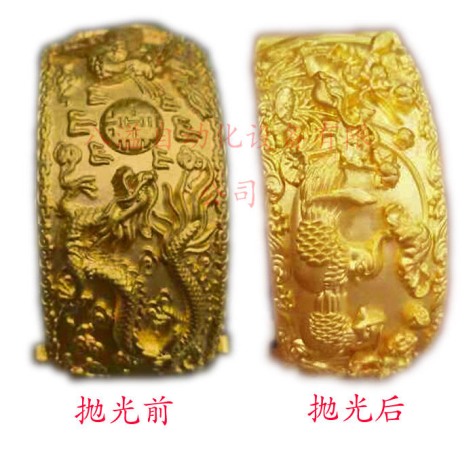
Additive-manufactured components: a typical part family for a plasma deburring and polishing cell with ultrasonic cleaning downstream.
Medical devices and implants. The BY-800A is documented for medical care and 3D printed dentures, and technical literature describes electrolytic plasma polishing as relevant to NiTi components for minimally invasive surgery, covering deburring, cleaning and improved corrosion resistance. The ultrasonic stage in these cells is not optional, because residue inside small-diameter lumens is a functional risk rather than a cosmetic one.
Jewelry and precious metals. The BY-500A is documented as a jewelry plasma polishing machine with a deburring rate of ≥ 99.9% and a fully automatic control system. For this part family the cell is usually compact: one polishing station, one cleaning tank, and a small wastewater stage, with hanger density driving output far more than current class.
Precision hardware and electronics. The BY-1000A is documented for 3C electronics, precision hardware and aerospace work. A documented reference of this pattern is Hebei Hengxin, which runs two BY-100A units for processing electronic accessories, has operated them for seven years with stable operation, and received guidance on installation from BAYI at commissioning.
Compliance and Parameter Constraints That Shape the Layout
CE marking is the constraint that most often reshapes a cell layout for the EU market, because the certificate scope has to match the actual machine list on the floor.
BAYI's CE certification for the plasma polishing machine is issued by Ente Certificazione Macchine under certificate number No.3N240806.DBAQC99, valid from 2024-08-06 to 2029-08-05. It relates to Directive 2006/42/EC (Machinery), 2014/35/EU (Low Voltage) and 2014/30/EU (Electromagnetic Compatibility), verified against EN ISO 12100:2010, EN 60204-1:2018, EN IEC 61000-6-2:2019 and EN IEC 61000-6-4:2019. The certificate holder is Dongguan Bayi Automation Equipment Co., Ltd, and the annexed model list covers BY-100A, BY-500A, BY-800A, BY-1000A and the BY plasma deburring machine.
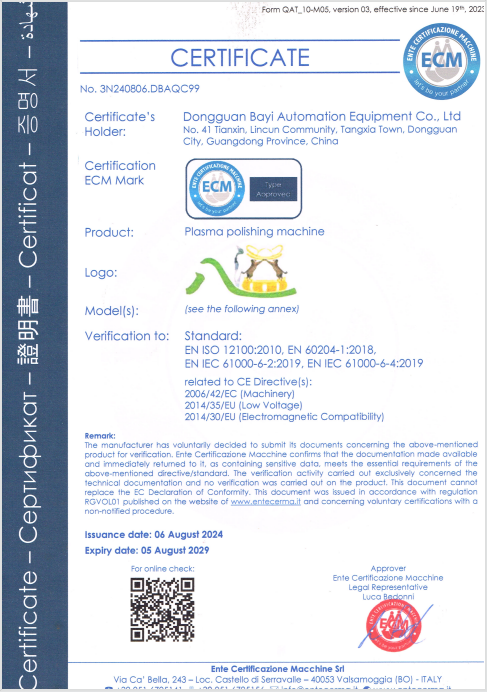
CE certificate No.3N240806.DBAQC99, issued by Ente Certificazione Macchine, valid 2024-08-06 to 2029-08-05.
Three practical consequences follow for cell design:
- Every plasma machine in the cell must be checked against the model list on the certificate, including any special build outside the standard range.
- The ultrasonic cleaning and wastewater units are separate machine categories, so their own conformity documentation has to be requested and verified rather than assumed from the plasma certificate.
- Electrical parameters drive the layout. A 30 kW, three-phase five-wire 380 V supply on a 100 A model sets the feeder size and the distance between the power cabinet and the tank, which is why the cabinet is planned as a second footprint rather than a wall-mounted accessory.
For cross-border movement, plasma cleaner and surface-preparation machines are often reported under HS code 8543.70 (other electrical machines and apparatus), with the classification confirmed against the importing country's tariff rather than assumed from a supplier invoice.
Frequently Asked Questions
Which machines in a combined cell need CE certification, and what does BAYI's certificate actually cover?
BAYI's CE certification for the plasma polishing machine is issued by Ente Certificazione Macchine under certificate number No.3N240806.DBAQC99, valid from 2024-08-06 to 2029-08-05, and is related to Directives 2006/42/EC, 2014/35/EU and 2014/30/EU. The verified standards are EN ISO 12100:2010, EN 60204-1:2018, EN IEC 61000-6-2:2019 and EN IEC 61000-6-4:2019, and the annexed model list names BY-100A, BY-500A, BY-800A, BY-1000A and the BY plasma deburring machine. Because the ultrasonic cleaning machine and sewage treatment equipment are separate product categories, their conformity documents should be requested individually before the cell is signed off for the EU market.
Can the cell be configured around non-standard part sizes, shapes and output levels?
Yes. BAYI's standard models are 100A, 300A, 500A and 800A, and non-standard models run from 1000A to 2500A. Equipment is designed according to the customer's product size, shape and yield, and special formats exist for continuous work: tape-type plasma polishing equipment that takes square material as a whole roll without cutting, chain-type equipment that automatically collects square material into a roll for polishing, and long-tube plasma polishing equipment for pipes over two metres in continuous production. Automation transformation and upgrading is offered as a separate service for buyers who already own part of the line.
What drives the cost of a three-process cell?
Cost is driven by configuration rather than by a published price list. The main drivers are the current class and model of the plasma stage, the hanger space required for the largest part, the level of transfer automation, matched ancillary equipment such as fume or dust extraction and wastewater treatment, and the extent of validation required at acceptance. BAYI quotes per configuration with a minimum order quantity of one unit and applies 100% testing, so an accurate quotation depends on the part family list and the required surface result being defined first.
How should a buyer validate parts before committing to a full cell?
Validation should reproduce the intended sequence rather than test one machine in isolation. BAYI provides a mechanical test report and video factory inspection, applies 100% testing to its equipment, and offers remote support after delivery, including guidance on installation. A useful precedent is Hebei Hengxin, which operates two BY-100A units for electronic accessories and has run them for seven years with stable operation. The acceptance list should cover surface result after polishing, residue after cleaning, and dimensional stability of the part.
What lead time and production capacity sit behind an integrated cell?
BAYI reports a standard lead time of 30–45 days, a monthly capacity of 70,000–110,000 medium parts and an annual output of 200,000 units, with a minimum order quantity of one unit and core component warranty of one year. The company was established in June 2017, operates an 800 m² factory with 50 employees and a three-engineer R&D team, and exports to North America, Europe and Southeast Asia. Buyers who want to review the full equipment range before requesting a cell configuration can download the BAYI product brochure (PDF) or send the part family list directly to the technical team.
Conclusion
A plasma polishing, deburring and ultrasonic cleaning cell succeeds or fails on three engineering decisions: whether the hanger envelope fits the largest part, whether the part moves from electrolyte to cleaning liquid fast enough to prevent residue from drying, and whether the liquid and exhaust circuits are separated before the first tank is filled. Machine selection comes after those three questions are answered, not before.
The documented hardware makes the rest of the build predictable. BAYI's range covers standard plasma platforms from 100A to 800A, non-standard builds from 1000A to 2500A, continuous formats for tape, chain and long-tube work, ultrasonic cleaning and sewage treatment, and CE certification No.3N240806.DBAQC99 covering the main polishing and deburring models through 2029-08-05. What remains is the buyer's own part family list, acceptance criteria and site services.
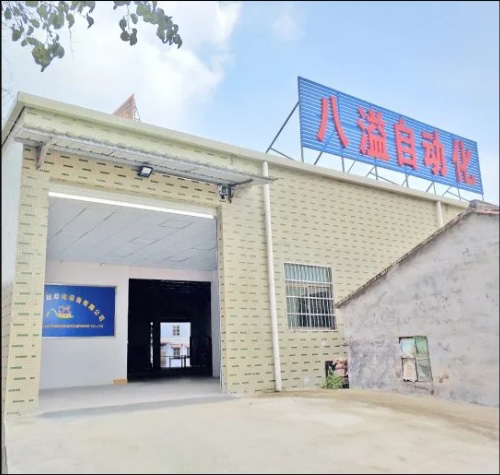
BAYI production facility, Dongguan — standard and custom plasma polishing, deburring and cleaning equipment.
Next step: specify your cell from your own part data
Send BAYI a part family list (material, maximum dimension, burr location, monthly volume) and the team will return a recommended plasma model, hanger space, transfer mode and cleaning configuration. Sample evaluation, mechanical test reports and video factory inspection are available before an order is placed.
Email: tanzhengao@bayiauto.cn | Tel: +86 15282129198 | WhatsApp: +86 18565939648
Address: No.41 Tianxin, Lincun Community, Tangxia Town, Dongguan, Guangdong, China
Website:metalsurfacefinishingequipment.com | Download the brochure
Have Questions or Need More Details?
Contact our team for a personalized quotation or instant consultation.
Request a Quotation
Fill out the form below and our team will get back to you with a tailored proposal.
WhatsApp Direct Chat
Prefer to chat in real-time? Message us on WhatsApp for instant assistance & quick answers.
- Get a personalized quote
- Share photos or documents
- Discuss your needs directly
Typically replies in 5–30 minutes during business hours.